How to Scale Your Website Revenue to $10k/Month (2026)
The strategy that works at 1,000 visitors will quietly destroy your revenue at 100,000. Here's the exact playbook for every stage.
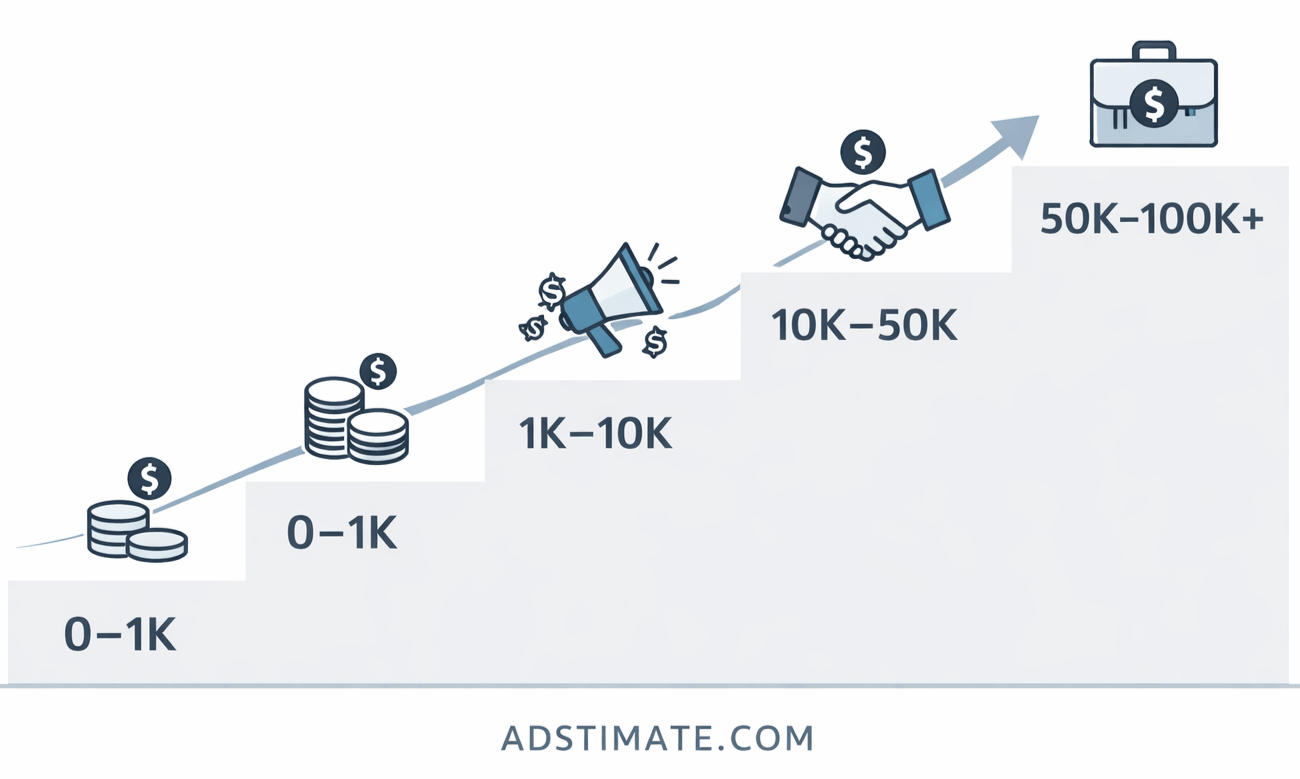
Two publishers. Same niche. One has 8,000 monthly visitors and earns $3,200. The other has 45,000 monthly visitors and earns $1,100. The second publisher has nearly six times the traffic and less than half the revenue. That's not bad luck. That's a strategy mismatch — using the wrong monetization approach for the wrong traffic level.
This is the mistake that quietly kills more websites than algorithm updates or niche competition combined. Publishers either start monetizing too early with the wrong tools, or they scale their traffic without ever evolving their revenue strategy to match it. The result is a site that grows in every metric except the one that matters.
Here's the principle that anchors everything that follows: your website monetization strategy must evolve at every 10x traffic jump. What built your first $100 will not build your first $10,000. And what feels like the "safe" default at every stage — slapping AdSense on everything and waiting — is usually the most expensive mistake you can make.
Phase 1: The Ghost Town (0 – 1,000 Visitors)
Focus: Digital Asset Plumbing
Forget ads. Completely. Putting AdSense on a site with 500 monthly visitors doesn't just earn pennies — it actively costs you. Ad scripts slow your page load, damage your Core Web Vitals, and signal to Google's quality systems that you're optimising for monetization rather than reader value. At this stage, every fraction of a second of page speed is worth more than any ad impression you'll collect.
Your only measurable goal at Phase 1 is email capture. One engaged subscriber is worth approximately $1 per month in lifetime revenue when you account for eventual product sales, affiliate commissions, and sponsored newsletter slots. That sounds small. At 1,000 subscribers, it's $1,000/month in latent value sitting in a list you own — independent of any algorithm, any ad network, and any traffic fluctuation.
If you need cash now, don't wait for passive income to materialise. Use your content as a portfolio and sell the expertise directly. A site publishing detailed software tutorials can sell consulting at $150–$500 per hour to the same audience it's trying to grow. Service arbitrage — converting content authority into high-ticket services — is the only reliable path to real income at sub-1,000 traffic. Everything else at this stage is noise.
Phase 2: The Niche Authority (1,000 – 10,000 Visitors)
Focus: Affiliate Precision
This is where most publishers make their first major strategy error: they sign up for Amazon Associates, add a few product links, and earn 1–3% commissions on purchases that happen to occur within a 24-hour cookie window. That's not affiliate marketing. That's leaving money on a table someone else built.
The Adstimate calculator estimates your monthly revenue based on your niche, country, and pageview volume — using real 2026 benchmark data. Takes 30 seconds.
Try Adstimate AdSense CalculatorAt 1,000–10,000 monthly visitors, your leverage point is direct brand affiliates and SaaS recurring commissions. A SaaS product paying 30% monthly recurring commission on a $99/month subscription earns you $29.70 every month that customer stays — from a single conversion. Ten of those conversions is $297/month in recurring revenue that compounds without additional traffic. Compare that to Amazon's model and the difference is structural, not marginal. To understand why AdSense alone underperforms at this traffic level, the math is straightforward — the RPM on 5,000 visits simply can't compete with the commission structure of well-chosen affiliate partnerships.
The content format that drives this is the comparison engine — "Tool A vs Tool B," "Best X for Y," "X Alternatives." These are the highest buyer intent pages you can build at this stage, and they convert at rates that informational content simply cannot match. A single well-ranked comparison post in a SaaS niche with a 2.4x niche multiplier — Software/SaaS sits at 2.4x in Adstimate's benchmark data — can generate more revenue in a month than your entire informational content library combined.
This is also the stage to introduce programmatic SEO for long-tail keyword scaling. Building templated pages that target hundreds of specific comparison and review queries feeds your affiliate links at scale without proportional content production costs.
Phase 3: The Mid-Tier Breakout (10,000 – 50,000 Visitors)
Focus: Premium Programmatic
At 10,000 monthly visitors, the display advertising conversation finally becomes worth having — but not with AdSense as your primary network. This is the threshold where managed ad partners like Mediavine and Raptive become accessible, and the revenue difference is significant. Where AdSense might deliver an RPM of $8–$15 on a mid-tier niche site, managed networks consistently deliver $20–$40+ on the same inventory through header bidding, direct demand relationships, and active optimisation. The full comparison of AdSense vs Ezoic vs Mediavine in 2026 lays out exactly when the switch makes financial sense.
The trap at this stage is adding ad units aggressively because the traffic finally justifies it. It doesn't. Scaling blog revenue through programmatic advertising is about viewability and auction quality — not unit volume. Fewer ads in better positions, on faster pages, earn more than a cluttered layout that tanks your Core Web Vitals and triggers MFA flags from premium DSPs. The mechanics of why are covered in detail in our guide on ad density and RPM — the short version is that less, placed better, consistently outperforms more.
Phase 3 is also where your email list starts generating direct revenue. A newsletter with 5,000–15,000 engaged subscribers can sell featured content slots to relevant brands for $200–$800 per send. That's revenue that exists completely outside the ad network ecosystem — no RPM fluctuations, no algorithm changes, no bidding wars. You set the price. You own the relationship.
Phase 4: The Media Empire (50,000 – 100,000+ Visitors)
Focus: Direct Deals and Ownership
At 100,000+ monthly visitors, you have leverage that most publishers never use. The programmatic networks that served you well in Phase 3 are now the floor, not the ceiling. Direct sponsorships — brands paying a fixed monthly fee for placement, mentions, or dedicated content — typically pay 2–3x what the same inventory earns through programmatic channels. The publisher who earns $4,000/month from network ads on 100,000 visits can often earn $8,000–$12,000 from three or four direct brand relationships covering the same real estate.
The Adstimate calculator estimates your monthly revenue based on your niche, country, and pageview volume — using real 2026 benchmark data. Takes 30 seconds.
Try Adstimate AdSense CalculatorThis is also the stage to stop selling other people's products and start owning the asset. A digital course built on the expertise your content has already demonstrated, a paid community, or a lightweight software tool solving a problem your audience repeatedly asks about — these shift your revenue model from traffic-dependent to audience-dependent. Traffic fluctuates. An audience that trusts you compounds.
There's a less-discussed opportunity at this scale that's becoming increasingly relevant in 2026: first-party data licensing. If your site has collected clean, consented user data — email lists, survey responses, engagement patterns — AI companies and market research firms are actively paying for access to niche-specific datasets. This isn't a primary revenue stream, but for publishers who have been building their email list since Phase 1, it's a meaningful secondary income that requires no additional traffic whatsoever. Publishers who ignored the revenue leaks common at high traffic levels rarely reach this stage with the infrastructure to take advantage of it.
Understanding the right balance between affiliate and display revenue at this stage becomes a genuine strategic decision rather than a default. At 100,000+ visits, you have enough data to know which pages convert for affiliates, which pages earn premium CPMs, and which pages are best reserved for direct sponsor placements. The mix is intentional — not whatever the ad network decides for you.
The 2026 Traffic-to-Revenue Matrix
Here's the quick-reference summary. Bookmark it. Come back to it every time your traffic crosses a new threshold and ask yourself honestly whether your strategy has kept pace.
| Traffic Stage | Primary Revenue Source | Secondary Focus | What to Avoid |
|---|---|---|---|
| 0 – 1k | High-Ticket Services | Email List Building | Display Ads entirely |
| 1k – 10k | Direct Affiliates (Recurring) | Lead Generation | Amazon Associates, AdSense as primary |
| 10k – 50k | Premium Ad Networks | Sponsored Newsletter Content | High ad density, AdSense-only setup |
| 50k – 100k+ | Own Products / Sponsorships | Brand Licensing / Data Assets | Passive-only revenue dependence |
The publishers who reach $10,000/month aren't the ones with the most traffic. They're the ones who matched their strategy to their stage, evolved it deliberately at each threshold, and never mistook a growing audience for a growing business. Those are two different things — and the gap between them is exactly where revenue either gets built or gets left behind.