Informational vs Buyer Intent Content: Which Makes More Money?
Same traffic. Completely different revenue. The gap isn't luck — it's intent. Here's how to close it.
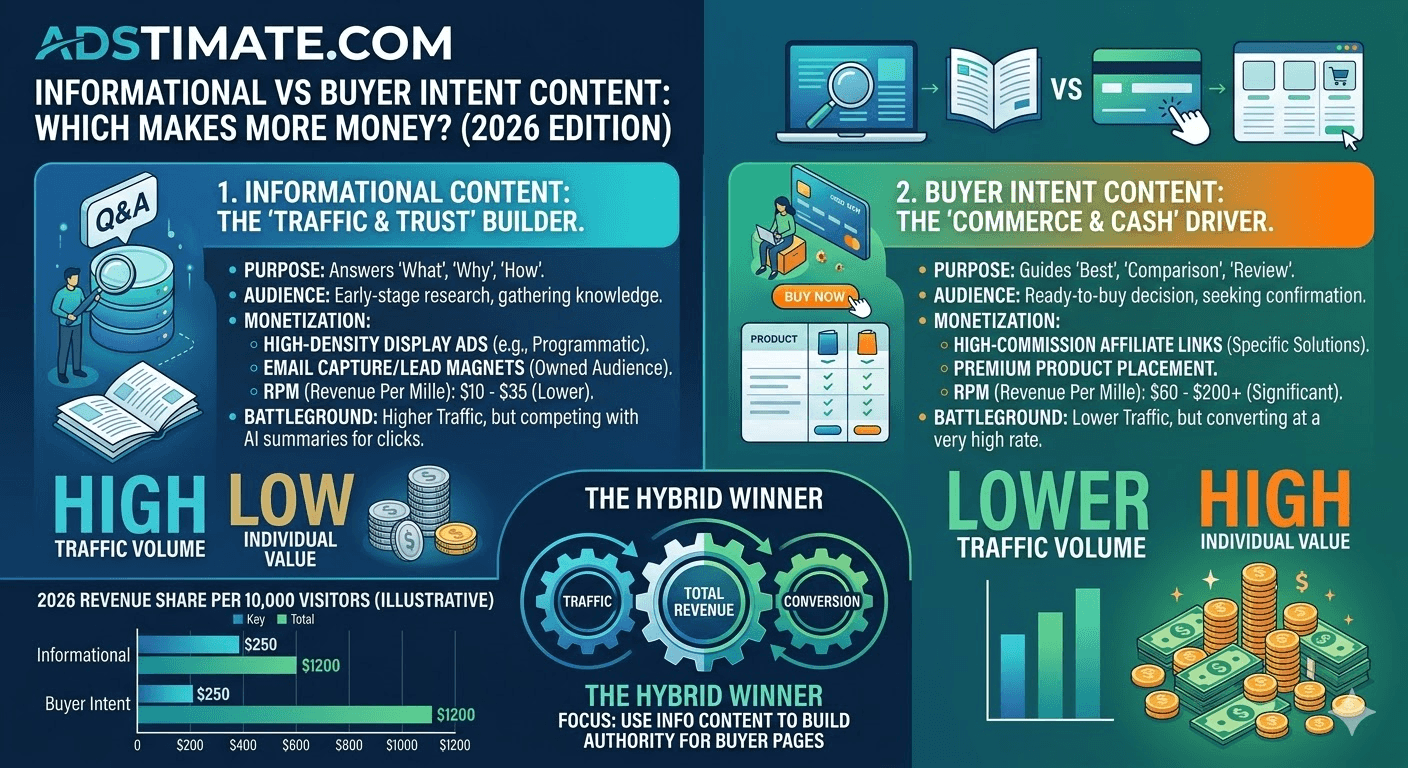
Two blog posts. Same niche. Same monthly traffic. One earns $12. The other earns $480. The writing quality is identical. The SEO is identical. The difference has nothing to do with either. It comes down to a single variable: intent. The visitor who arrived at the $480 post was ready to act — buy, compare, or decide. The visitor at the $12 post was just browsing. Advertisers know this, and they bid accordingly.
Before you write your next post, understand exactly what Google AdSense pays per 1,000 views in your niche — because intent-matched content and a high-RPM niche working together is the only combination that turns traffic into real money.
This is the gap that most publishers spend years trying to close by doing more of the same thing — more posts, more traffic, more optimization — without ever addressing the actual problem. Informational vs buyer intent content isn't just an SEO concept. It's the single biggest lever in your monetization strategy, and most sites are pulling the wrong one.
The Two Types of Traffic Most Bloggers Confuse
Every visitor who lands on your site is doing one of two things. They are either learning something, or they are deciding something. That distinction determines almost everything about what that visit is worth.
- Informational traffic — curiosity traffic — arrives with a question. "What is content marketing?" "How does compound interest work?" "Why is my AdSense RPM low?" They want an answer. They'll read, maybe bookmark, and leave. They are not close to a purchase decision. They are not comparing products. They are not ready to click an affiliate link with any conviction.
- Buyer intent traffic — decision traffic — arrives mid-process. "Best email marketing software for small business." "Surfer SEO vs Clearscope." "Jasper AI review 2026." These people already know what category of solution they need. They are evaluating options. They are one good article away from a decision. That's what buyer intent content targets — and that proximity to action is what makes it disproportionately valuable. Understanding how traffic value is actually calculated makes this gap concrete very quickly.
Why Informational Content Gets Traffic But Low Revenue
Does informational content make money? Yes — but not efficiently, and not on its own.
Informational content ranks well. It attracts volume. It builds topical authority and earns backlinks. These are real, compounding benefits that no serious publisher should ignore. The problem isn't that informational content exists on your site — it's when it dominates your site without a monetization path attached to it.
From an AdSense perspective, informational pages attract lower-tier advertisers. A page explaining "what is life insurance" earns a fraction of what a page comparing "best life insurance providers 2026" earns — even with identical traffic. The advertiser bidding on the comparison page knows the reader is about to make a decision. That proximity to purchase commands a premium. High intent keywords vs low intent keywords aren't just an SEO distinction — they're a direct revenue distinction that shows up in every impression auction on your page.
Affiliate conversions tell the same story. Readers in learning mode click affiliate links out of curiosity and rarely convert. Readers in decision mode click with purpose. The conversion rate difference between the two can be 10x or more on the same product.
Why Buyer Intent Content Makes Disproportionate Money
Lower traffic. Higher everything else.
A buyer intent page ranking for "best project management software for agencies" might pull 800 monthly visits. An informational page on "what is project management" might pull 8,000. By raw traffic metrics, the informational page looks like the winner. By revenue, it isn't close.
The buyer intent page attracts advertisers who know their audience is in purchase mode. CPCs go up. RPMs go up. Affiliate commissions arrive because readers are genuinely evaluating options and making decisions. This is the intent multiplier at work — the same niche, the same site, the same reader demographic, but a completely different auction outcome because the content signals commercial readiness rather than casual curiosity. The highest-paying AdSense niches are almost entirely built on commercial and transactional content — that's not a coincidence.
The content formats that consistently signal buyer intent: "best X for Y," "X vs Y," "X review," "X alternatives," "how much does X cost." These aren't just high-converting formats — they're the formats advertisers specifically target because the reader psychology is predictable.
The Adstimate calculator estimates your monthly revenue based on your niche, country, and pageview volume — using real 2026 benchmark data. Takes 30 seconds.
Try the Adstimate AdSense CalculatorThe Real Answer
Here's the stance: hybrid wins. Always.
Choosing between informational vs commercial intent content is a false binary that leads publishers into one of two traps. The first trap is a site full of informational content that ranks well, attracts real traffic, and earns almost nothing because there's no monetization architecture connecting the dots. The second trap is a site that skips informational content entirely, has no topical authority, and can't rank for the buyer intent keywords it's targeting because there's no supporting content ecosystem around them.
The sites that earn the most aren't choosing between content that converts vs content that gets traffic. They're building both — intentionally, with a clear understanding of what each type of content is supposed to do.
Not all traffic deserves the same monetization strategy. That's the line that changes how you think about your entire content calendar.
The Hybrid Strategy: What Smart Sites Actually Do
The architecture is straightforward once you see it. Informational content is the traffic engine. Buyer intent content is the revenue engine. The connection between them is internal linking — and most sites do it badly or not at all.
A well-structured hybrid site publishes informational content that ranks, builds authority, and attracts readers who are earlier in the decision process. Those articles include deliberate internal links to buyer intent pages — comparison posts, reviews, tool roundups — that catch the reader when they're ready to move from learning to deciding. The informational page doesn't need to convert. It needs to qualify and redirect.
This is also where the affiliate vs ads content strategy question gets resolved. Informational pages are better suited to display ads — the reader isn't in purchase mode, so affiliate links underperform, but ad impressions still generate revenue. Buyer intent pages are where affiliate links earn their keep, often outperforming display ads by a significant margin. Matching the monetization method to the content type is half the battle. The full breakdown of when each approach wins is in our guide on affiliate marketing vs display ads in 2026.
Revenue Breakdown: The Reality Check
Let's make the gap concrete with real numbers.
10,000 monthly visits to an informational page in a mid-tier niche will generate roughly $50–$150 in display ad revenue. That's a blended RPM of $5–$15 — standard for learning-mode content with moderate advertiser competition. To understand exactly how AdSense calculates what it pays per 1,000 views, intent is one of the most underappreciated variables in that equation.
2,000 monthly visits to a buyer intent page in the same niche? The display ad revenue alone can reach $80–$200 at a significantly higher RPM. Add affiliate commissions from a well-placed recommendation — even at a modest 1–2% conversion rate on a $50 product — and that 2,000-visit page generates $200–$1,000+ per month. From one-fifth of the traffic.
That's not a small difference. That's a fundamentally different business model built from the same niche, the same domain, and the same audience.
A SaaS review site with 12,000 monthly visits was outearning a competitor with 95,000 monthly visits in the same niche. Every page was buyer intent — comparisons, reviews, alternatives. The competitor had built a library. The review site had built a revenue engine.
When to Focus on Each — By Growth Stage
The right balance shifts as your site grows, and forcing buyer intent content too early is its own mistake.
- At 0–10k monthly visits, informational content is your primary tool. You don't have the domain authority to rank for competitive buyer intent keywords yet, and you need the topical depth that informational content builds. Focus on ranking, building backlinks, and establishing authority. Monetization at this stage is secondary — you're laying the foundation.
- At 10k–50k monthly visits, start introducing buyer intent content deliberately. You have enough authority to compete for mid-competition commercial keywords. Begin building internal linking structures that connect your informational library to the buyer intent pages you're adding. This is where the hybrid architecture starts generating compounding returns.
- At 50k+ monthly visits, scale buyer intent aggressively. You have the authority, the traffic base, and the internal linking infrastructure to push commercial content to the top of your production priority. Your informational content keeps ranking and feeding the funnel — but your revenue growth will come disproportionately from the buyer intent pages you publish from here.
The Hidden Mistake Killing Most Sites
Too much informational content with no path out of it. That's the mistake. And it's everywhere.
A site with 200 informational posts and zero buyer intent pages has built a library with no checkout counter. Readers arrive, learn, and leave — with no mechanism to convert that attention into revenue. No internal links to money pages. No comparison content. No reviews. No funnel. Just traffic that looks impressive in GA4 and earns almost nothing in the dashboard.
This is the root cause behind why high-traffic sites still make low ad revenue — it's not always a technical problem. Sometimes it's a content architecture problem. The traffic is real. The monetization path simply doesn't exist.
A personal finance blogger had 180,000 monthly sessions and earned $380/month from AdSense. Every single post was informational — explainers, definitions, how-it-works guides. Beautiful content. Zero buyer intent pages. She added 8 comparison posts over three months. Monthly revenue hit $2,100. The informational posts didn't change. The architecture did.
How to Turn Informational Traffic Into Revenue
You don't need to delete your informational content. You need to connect it.
Go through your top 10 informational pages by traffic. For each one, identify the buyer intent page it should be linking to — the comparison post, the review, the "best X" roundup. If that buyer intent page doesn't exist yet, create it. If it does exist, add the internal link and make it contextual — not a sidebar widget, not a "related articles" box, but a sentence within the content that naturally transitions the reader from learning to evaluating.
The second fix is adding comparison sections to informational content. A post explaining "what is email marketing software" doesn't have to stay purely informational. A section near the end — "If you're ready to pick a tool, here's how the top options compare" — bridges the intent gap without changing the primary purpose of the article. How to monetize informational content isn't about turning every article into a sales page. It's about building the bridge between learning and deciding, and making sure it's there when the reader is ready to cross it.
Final Take
Traffic feels good. Revenue builds businesses.
Informational content gives you reach. Buyer intent content gives you returns. The publishers who understand this don't treat them as competitors — they treat them as a system. One feeds the other. Neither works as well without the other. And the internal links between them are the mechanism that turns a content library into a monetization engine.
Build both. Connect them deliberately. Match your monetization method to the intent of each page. That's the blog monetization strategy content types framework that holds up at every traffic level — from your first 1,000 visits to your first million.