Why High Traffic Websites Still Make Low Ad Revenue (And How to Fix It)
Traffic Looks Good on Paper. Revenue Tells the Truth.
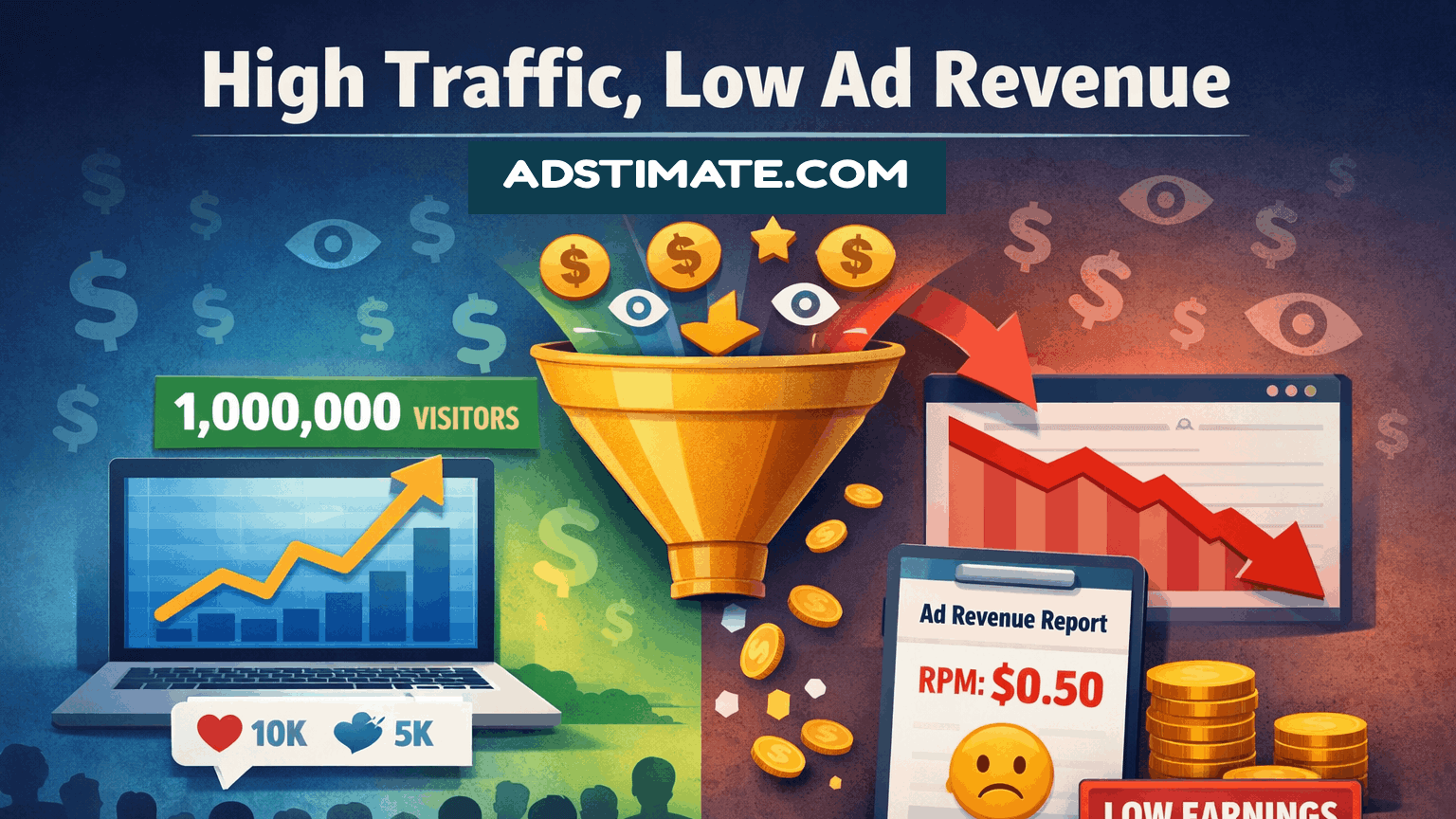
A million pageviews and a $2 RPM. That's not a success story — that's a leaking pipe. You've built the audience, done the work, and the dashboard still looks like it belongs to someone who launched last week. Sound familiar?
Here's the uncomfortable truth: high traffic does not guarantee high ad revenue. In 2026, ad networks don't pay for eyeballs. They pay for high-intent first-party data — the kind that tells an advertiser exactly what a person is about to buy. If your traffic doesn't signal that, your auctions stay cheap, and your RPM stays stuck.
Let's pull this apart properly. No fluff. Just the actual reasons your revenue is bleeding — and how to stop it.
The "Empty Calories" Trap: Traffic Quality Over Traffic Volume
Not all traffic is created equal. Not even close.
Use the Adstimate calculator to benchmark your RPM and identify exactly where your revenue is leaking.
Try Adstimate AdSense CalculatorPicture this: a post goes viral on Facebook. Three hundred thousand people click through in 48 hours. Your RPM for those two days? Probably $0.80. Now compare that to a site ranking on page one for "best business insurance for freelancers." Five thousand visitors. RPM of $18. That's the difference between Empty Calories traffic and high-intent search traffic.
Social traffic scrolls. Search traffic shops. Advertisers know this, and they bid accordingly. When your traffic mix is dominated by viral, low-intent sources, the entire auction pool for your site drops in value — dragging your site-wide RPM down with it.
Then there's the geography problem. A surge in Tier 3 traffic — think high volumes from markets with very low advertiser spend — can physically lower your average RPM even if your Tier 1 traffic stays flat. You're not earning more. You're just diluting what you already had. Check your AdSense RPM by country benchmarks — the gap between a US visitor and a visitor from a low-spend market can be 10x or more.
The Ad Tech Leak: Where Your Money Disappears Before You See It
Even when the right visitor lands on your page, there are invisible hands in the till before a single cent reaches your dashboard.
Bid shading and SSP fees are the silent killers most publishers never audit. Every impression flows through a chain of intermediaries — Supply-Side Platforms, exchanges, verification layers — and each one takes a cut. By the time the winning bid travels from the advertiser to your account, you may be receiving 60 cents of every dollar paid. You never see the other 40%.
Then there's layout latency. If your ads load two seconds after the user has already scrolled past the placement, your viewability score is effectively zero. Advertisers pay a premium for viewable impressions — ads that are actually seen. If your units are loading late because your page is slow, you are being treated as a low-quality inventory source, and your bids will reflect that. This is directly connected to your Core Web Vitals. A poor CLS or LCP score doesn't just hurt your SEO rankings — it throttles the premium exchanges that only serve fast, stable pages.
Content-Ad Mismatch: Why Context Is Your Biggest Lever
Ad networks are context engines. They scan your page, identify the topic, and match it to relevant advertiser categories. The tighter that match, the higher the bids.
A general news site covering everything from celebrity gossip to local weather gives the algorithm nothing to work with. The contextual signal is weak, so the ads served are generic, and generic ads pay generic rates. Meanwhile, a niche site publishing detailed guides on "how to fix a boiler" or "best accounting software for self-employed" gives advertisers a precise, high-value audience. The CPC for those categories can be 5 to 10 times higher.
This is the Information Gain gap — the difference between content that answers a question thoroughly and content that merely addresses a topic. High-traffic sites often scale by broadening their scope. And in doing so, they quietly destroy their contextual value. To understand what your niche is actually worth to advertisers, use the highest-paying AdSense niches guide as your benchmark.
There's also the Auto Ads problem. High-traffic sites frequently over-rely on Auto Ads, which means the algorithm is placing units wherever it finds space — not where your readers are most engaged. The premium money spots in long-form content (just below the first heading, mid-article, and just before the conclusion) get skipped entirely. For a full breakdown of this, read our piece on Auto Ads vs. Manual Units in 2026.
The UX-Revenue Conflict: The Density Paradox
More ads should mean more money. Except when it doesn't.
Ad blindness is real and it's measurable. When users see too many ad units clustered on a page, their brains learn to ignore them — including the ones you're counting on for revenue. You end up with high impressions and terrible CTR. The units are loading. Nobody is clicking.
Worse, ad clutter signals low quality to Google's systems. Sites with poor ad density management get throttled by premium demand partners. The high-paying finance and insurance advertisers — the ones whose bids you actually want — have quality thresholds. If your page looks like a banner farm, they simply don't bid. You're left with the bottom of the auction: remnant inventory, low CPC, the scraps.
Poor Core Web Vitals compound this further. If your Largest Contentful Paint is slow or your layout shifts constantly during load, you get "throttled bidding" from premium exchanges. They're not punishing you consciously — their systems just deprioritise inventory that scores poorly on performance. The fix here is discipline: fewer, better-placed units rather than maximum density. Use heatmap data to identify your genuine high-CTR zones instead of guessing.
The 5-Step Revenue Recovery Roadmap
You've seen the leaks. Here's how to plug them — in order of impact.
- The Niche Pivot. Review your top 20 traffic pages. Which ones cover high-CPC topics — finance, legal, health, software, insurance? Double down on those. Write more content in those categories. Let the low-intent, low-CPC pages exist, but stop feeding them with new content investment. Your content calendar is an RPM lever. Treat it like one.
- The Viewability Audit. An ad that loads but isn't seen earns nothing. Use Google Ad Manager or your AdSense dashboard to check your viewability percentage per unit. Anything below 50% needs to be repositioned or removed. Ads should be where eyes already are — not where there's empty space.
- Header Bidding Implementation. This is the single biggest RPM unlock for mid-to-large publishers. Header bidding forces multiple demand partners — not just Google — to compete for every impression simultaneously. Google's default waterfall auction gives them a first-look advantage that depresses competition. Remove that advantage and your average CPM will climb. If you're not yet at the traffic threshold for full header bidding, look at Ezoic or Mediavine as managed alternatives that do this for you.
- First-Party Data Collection. Anonymous traffic is cheap traffic. When a visitor is logged in, has consented to data use, and has a browsing history — they become a high-value addressable target. Even basic email capture or a free tool that requires registration starts building a first-party data asset. Advertisers pay a premium to reach known audiences. The difference in RPM between anonymous and known traffic is significant and only growing as third-party cookies continue to deprecate.
- Ads.txt and Crawler Cleanup. This is the one people skip and then wonder why their revenue is 20% lower than it should be. An incomplete or error-filled Ads.txt file means premium demand partners cannot verify you as an authorised seller. They simply don't bid. Invalid crawlers inflating your session counts also distort your GA4 data, making it impossible to audit the above steps accurately. Fix the foundation before you optimise anything else. A full walkthrough is in our guide on fixing Ads.txt and crawler errors.
The Bottom Line
Traffic is the start of the conversation, not the end of it. A million visits means nothing if the auction sees low-intent signals, your ads load after the scroll, your content has no contextual identity, and your technical setup is leaking demand partners at every step.
Fix the quality of what you send. Fix the speed of what loads. Fix the relevance of what you write. Then — and only then — will the numbers on your dashboard start reflecting the work you've actually put in.
If you're starting to wonder whether the revenue ceiling on your current setup is a platform problem rather than a strategy problem, it might be worth reading our breakdown of when to combine affiliate marketing with display ads — because for some traffic profiles, display ads alone will never get you where you want to go.