Auto Ads vs. Manual Units: Which Setup Earns More in 2026?
Google wants you to believe that their AI is a benevolent genius. They want you to flip a single "Auto Ads" toggle, go sit on a beach, and watch the dollars roll in. It sounds like a dream, right? But if you’ve been in this game for more than ten minutes, you know that when Google offers to "do the work for you," they’re usually the ones getting the better end of the deal.
The jagged truth? In 2026, relying 100% on Auto Ads is the fastest way to turn your website into a digital dumpster fire. It kills your user experience, drags down your site speed, and—worst of all—leaves a massive chunk of change on the table.
If you want the best AdSense ad placement strategy for high RPM, you have to stop being passive. You need to take the wheel.
The Great 2026 Performance Showdown
Let’s look at the Auto Ads vs Manual Units 2026 performance data. Auto Ads are built on machine learning. The algorithm looks at your site and says, "Hey, there’s some white space! Let’s shove a banner there!" It doesn't care about your "Information Gain." It doesn't know that your most valuable insight—the one that keeps readers on the page—is buried in paragraph four.
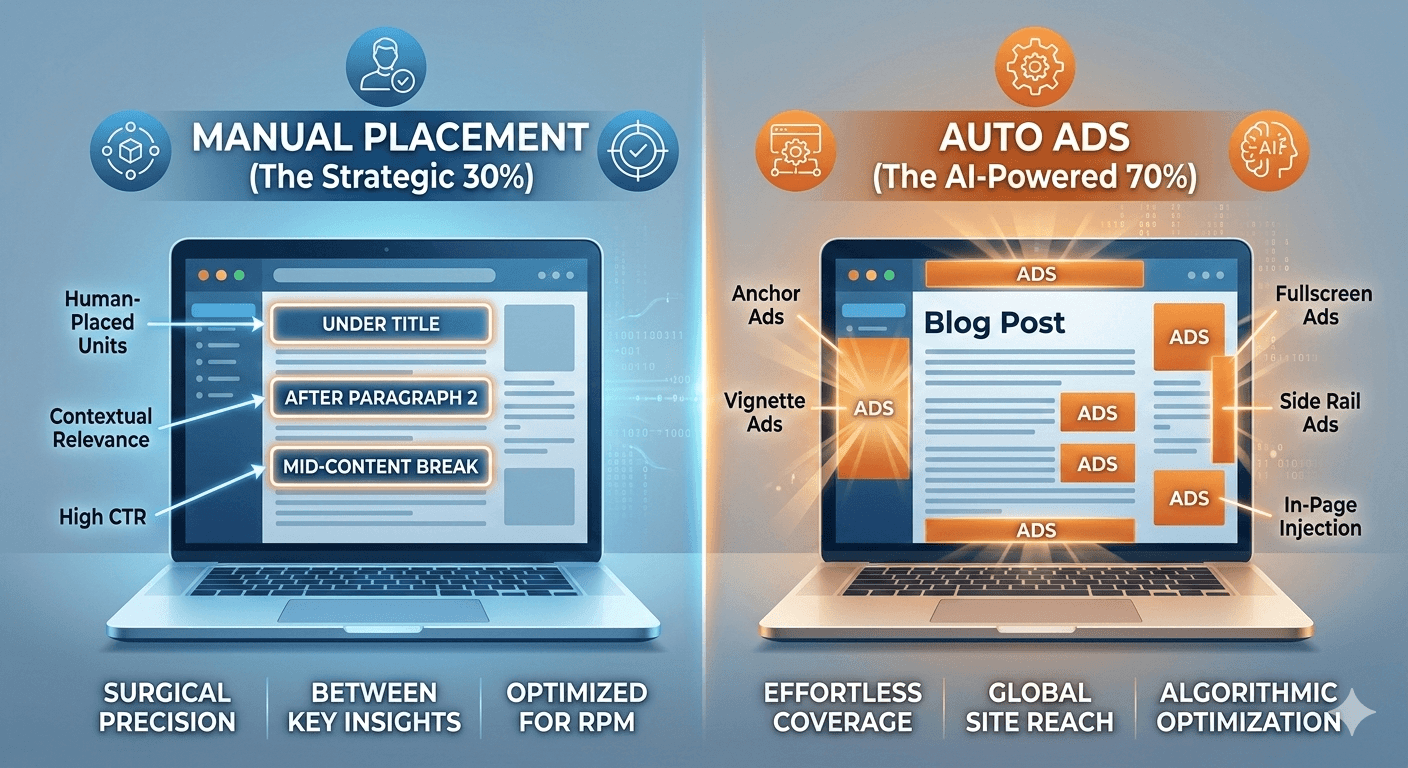
Manual placement, however, is surgical. You know where the eyes go. You know where the "click-intent" peaks. When we run an Auto Ads vs Manual Ads revenue comparison, manual units almost always win on Click-Through Rate (CTR) because they are contextually relevant.
The verdict? Manual is for the money; Auto is for the "lazy" coverage. But the real pros? We use a AdSense hybrid ad setup guide to get the best of both worlds. Before choosing a setup, it is vital to understand the baseline of how much AdSense pays per 1,000 views in your specific niche.
Why You Should Combine Auto Ads and Manual Placements
Neutrality is for people who don't have bills to pay. I’m telling you right now: The 30% Rule is the law of the land in 2026.
You should aim for a setup that is roughly 30% manual units (placed in the high-value "money zones") and 70% Auto Ads (handling the high-tech, sticky formats like Anchors and Vignettes). Why? Because manual units allow you to place ads between the most valuable sections of your text—the stuff Auto Ads often miss. This is what we call Ad Fatigue Protection. By controlling the flow, you prevent "ad blindness" and keep your readers engaged instead of annoyed.
Optimizing AdSense Ad Density for UX (and Your Sanity)
Ever visited a site and felt like you were trying to read a blog post through a picket fence of banners? That’s what happens when you don't focus on AdSense ad density for UX. In 2026, Google’s AI is aggressive. If you give it total control, it will clutter your header, footer, and every single sidebar until your bounce rate hits the moon.
You need to be the gatekeeper. High bounce rates tell Google your content isn't helping, and that leads directly to "Low Value Content" rejections or ad limits. Keep it clean. Keep it fast.
Impact of Auto Ads on Core Web Vitals (CWV)
Let’s talk tech for a second. The impact of Auto Ads on Core Web Vitals (CWV) is a silent killer. Every time an Auto Ad "injects" itself into your layout, it causes a layout shift (CLS). Google hates layout shifts. If your site jumps around while loading ads, your rankings will tank. Manual units are "static"—they have a reserved spot, meaning zero shift and better SEO.
The Manual "Money Zones": Best Ad Locations for Mobile in 2026
If you’re going manual, you need to know where the gold is buried. Here are the best manual ad locations for mobile in 2026:
- Under the First Paragraph: Don't put it at the very top (it looks like spam). Put it right after your hook.
- After the First H2 Heading: This is where the reader pauses to digest information. It's the highest-performing spot on the page.
- The Mid-Point Break: In auto ads for long-form content vs short-form, long-form wins only if you break up the text. Stick a manual unit right in the middle of a 2,000-word guide.
AdSense Anchor Ads vs Vignette Ads Performance
While I hate Auto Ads for in-content placements, I love them for "technical" formats.
- Anchor Ads: These stick to the top or bottom of the screen. They are the 2026 kings of steady revenue.
- Vignette Ads: These are the full-screen ads that appear between page loads. They have a massive CTR.
When comparing AdSense Anchor ads vs Vignette ads performance, Vignettes usually have a higher CPC, but Anchors provide more consistent volume. Let Auto Ads handle these; they’re hard to code manually and the AI actually does a decent job with them.
Troubleshooting: "Why Are My Auto Ads Not Showing?"
"I turned the switch on, but nothing happened!" Sound familiar?
If you're wondering why are my Auto Ads not showing in 2026, it’s usually one of three things:
- The Ads.txt file: If this isn't verified, you’re invisible.
- Conflict: Often, you'll find manual ads not displaying with Auto Ads enabled because the scripts are fighting for the same space.
- Ad Limits: If Google thinks your traffic is 'invalid,' they’ll pull the plug... leading to ad serving limits without telling you.
Also, watch out for an AdSense revenue drop after enabling Auto Ads. This usually happens because the AI is suppressing your high-performing manual units to show lower-paying "optimized" ones. If this happens, go into your settings and learn how to disable Auto Ads on specific pages or formats immediately. If the bot refuses to play fair even after your fixes, it might be time to look at AdSense alternatives for small websites to keep your cash flow alive.
The Final Setup: Side Rail Ads vs Anchor Ads RPM
In 2026, desktop users are seeing a resurgence of "Side Rail" ads (those thin banners on the left and right of the content). When comparing AdSense Side Rail ads vs Anchor ads RPM, Side Rails are surprisingly effective for "sticky" sidebar layouts.
But for most of you, mobile is 80% of your traffic. Don't obsess over the sidebar if your mobile layout is a mess. Use manual ad units for WordPress best plugins 2026 (like Ad Inserter) to ensure your manual placements are responsive and clean.
The Bottom Line
Stop treating your website like a "set it and forget it" experiment. If you want to scale, you need to be a strategist. Use Auto Ads for the sticky stuff (Anchors/Vignettes) but keep the "Money Zones" in your content strictly manual.
You’ve worked too hard on your content to let a bot decide how to monetize it. Take back control, fix your density, and start watching your RPM actually reflect the value you’re providing.